Search
Research
This way
→
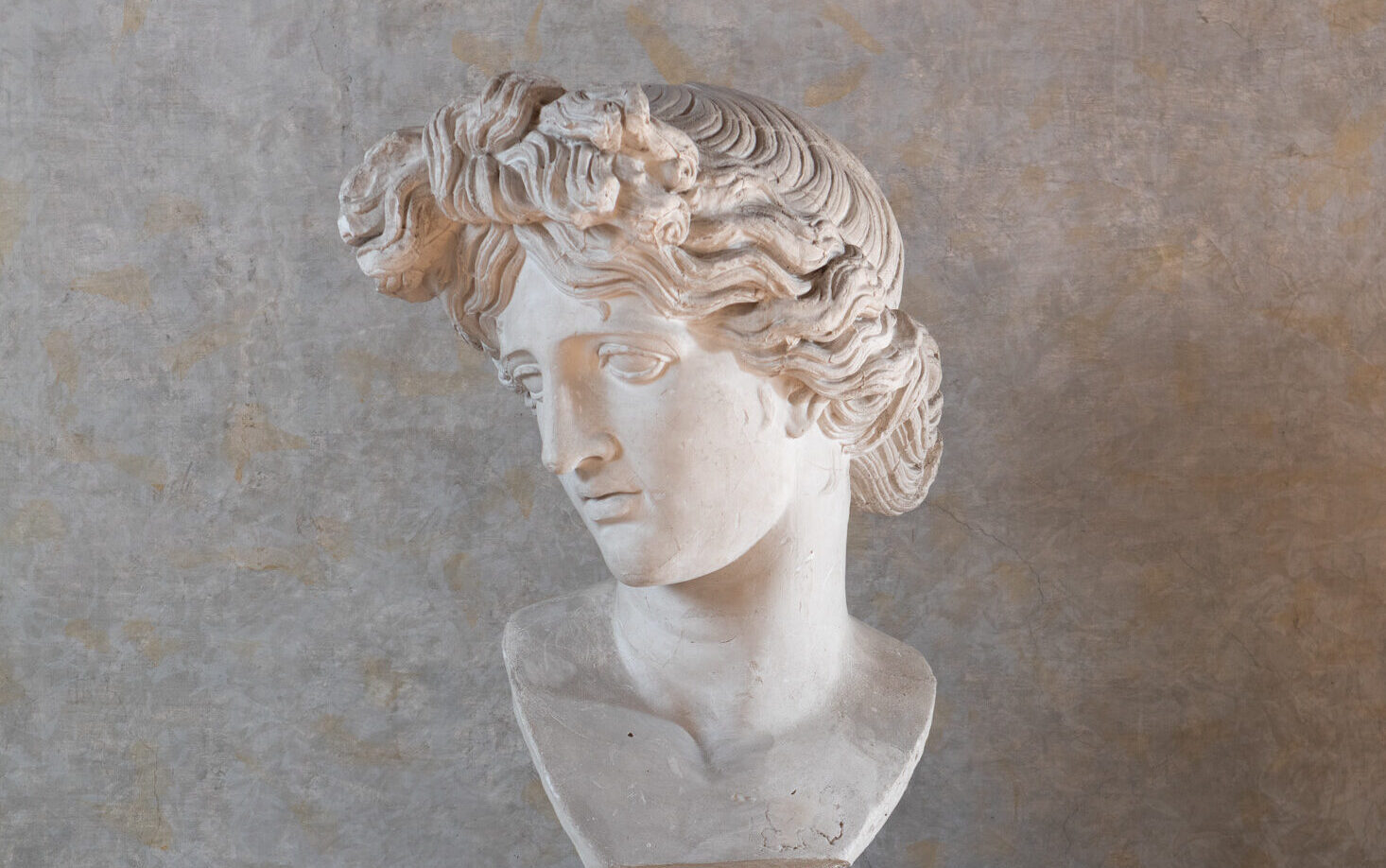
Founded in 1970 on the initiative of André Chastel (1912–1990), the Department of Art History is dedicated to supporting research across all areas of the discipline by promoting an interdisciplinary approach. It is responsible for the conservation, restoration, promotion and expansion of the collections, as well as the library and archive holdings. It also contributes to cultural programming by organising conferences, study days, seminars and research workshops. Furthermore, it promotes, coordinates and oversees publishing activities, particularly academic publications.
Scientific Programming and Research Projects
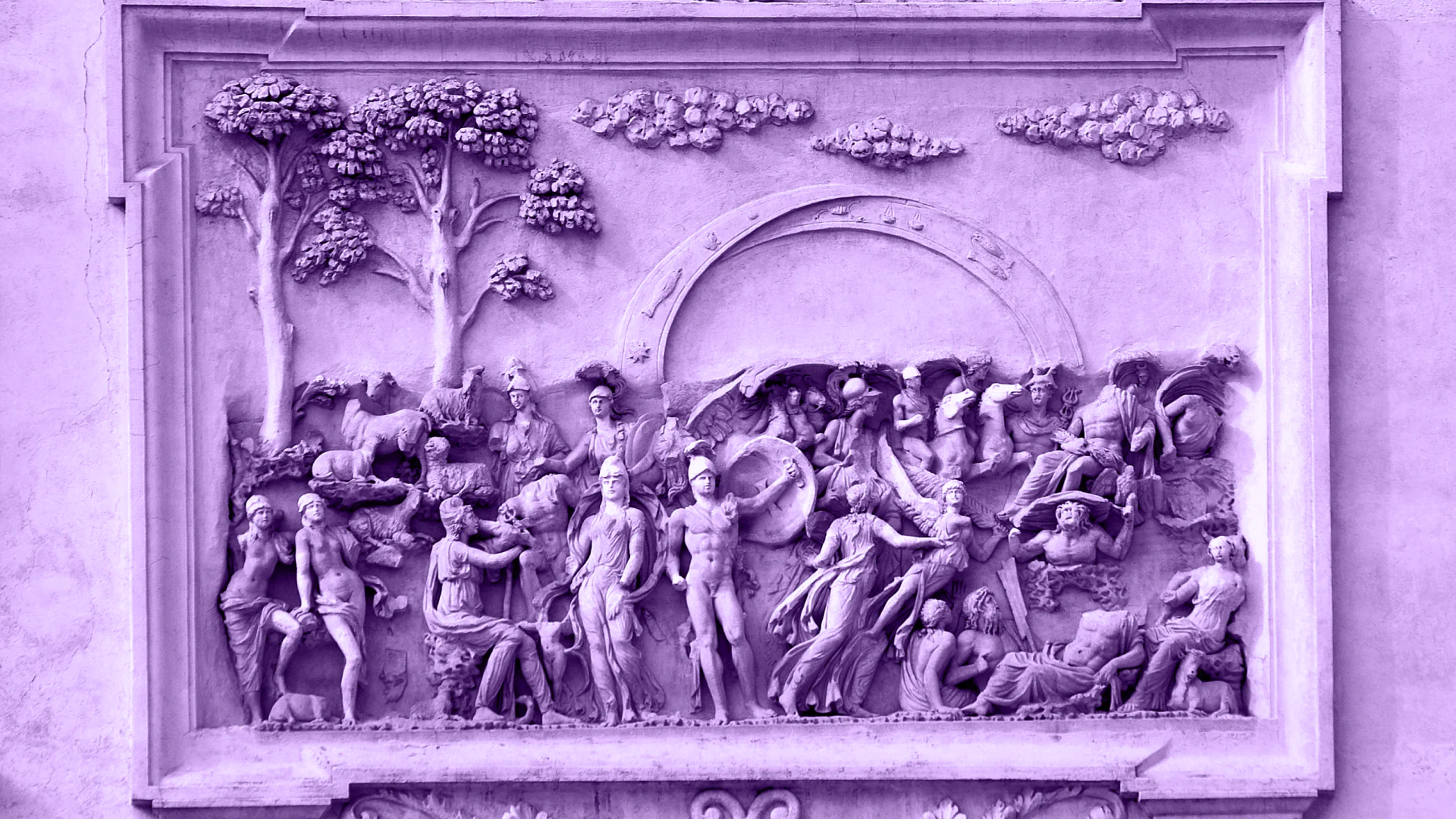
The Department of Art History promotes research based on a diversity of methodological approaches and cross-disciplinary dialogue. Its projects focus primarily on the modern and contemporary periods and cover all geographical areas, with a particular emphasis on the Mediterranean.
Since 2026, the Department of Art History and the French School of Athens have been developing a research programme entitled ‘The French School of Athens & the French Academy in Rome: A Shared History (1845–1945)’. This programme examines the institutional mobility of artists and scholars in the Mediterranean, as well as forms of fellowship, movements of people, the relationship between art and the humanities, and the political dimension of artistic and archaeological practices. It gives rise to research workshops, study days, conferences, publications and exhibitions.
This programme builds on a line of inquiry into the role of architecture within the French Academy in Rome. Brought together under the title ‘Architectures and Architects at the French Academy in Rome: Perspectives, Works and Networks (19th–21st centuries)’, this research combines the study of heritage, the promotion of archives and collections, the organisation of symposia and study days, and scholarly publications.
Previously, the Department led the five-year Carracci ConservArt (2022-2026) in collaboration with numerous international institutions.
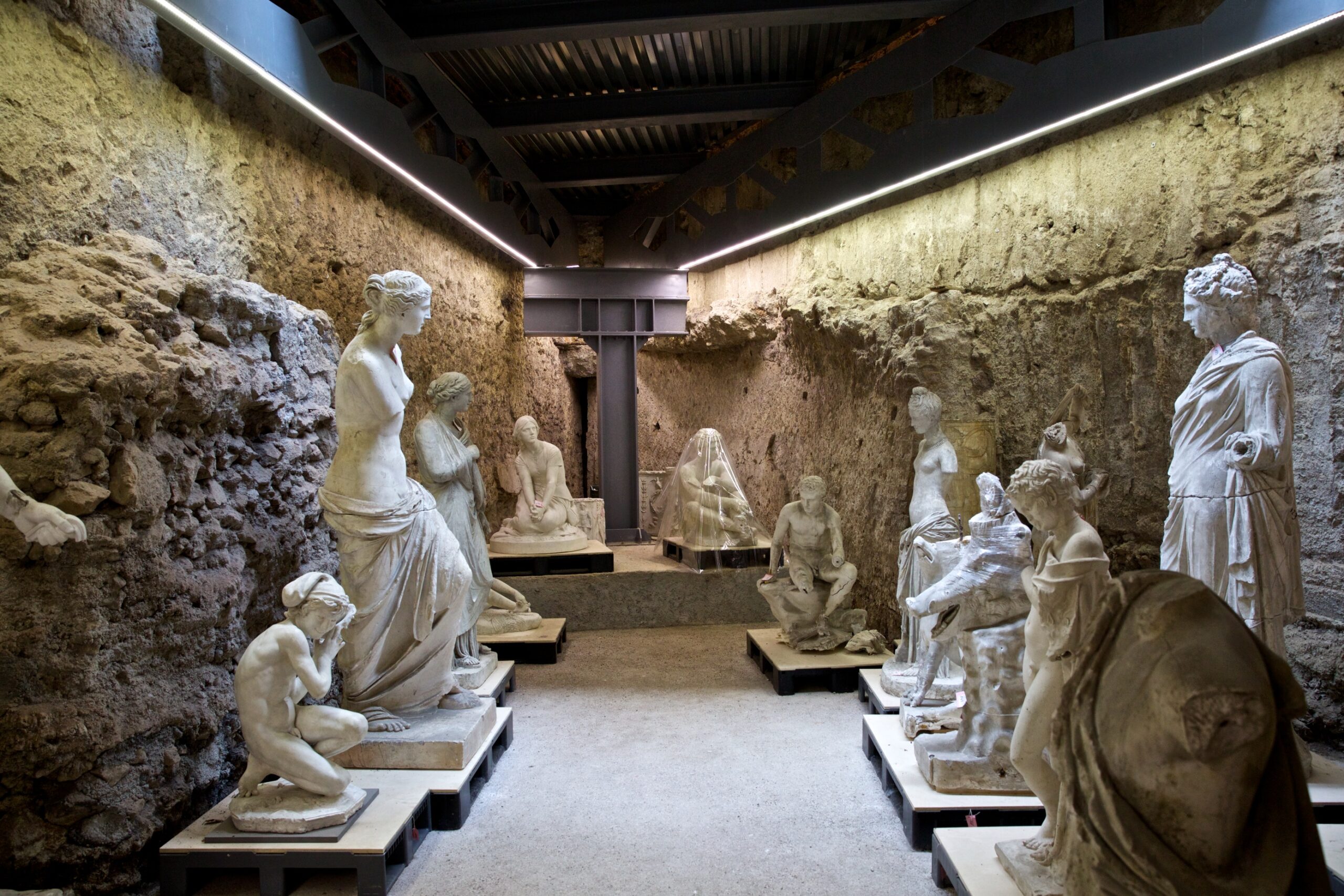
Villa Medici plaster reserve
© AFR

Glass elements, archaeological material, c. 1st century BC – 1st century AD, discovered in 2012 at Villa Medici
© AFR

Alfred-Nicolas Normand (1822-1909), Details of the decorative motifs on the roof of Messina Cathedral, 1846-1891
© AFR
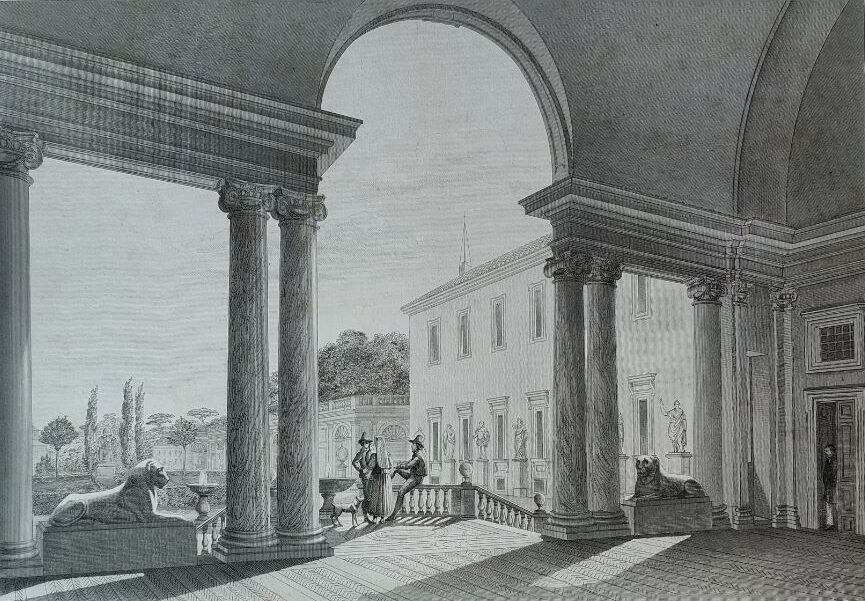
A. Varin after Victor Baltard, Villa Medici in Rome: View of the Grand Lodge from the Gardens, 1847, lithograph
© AFR
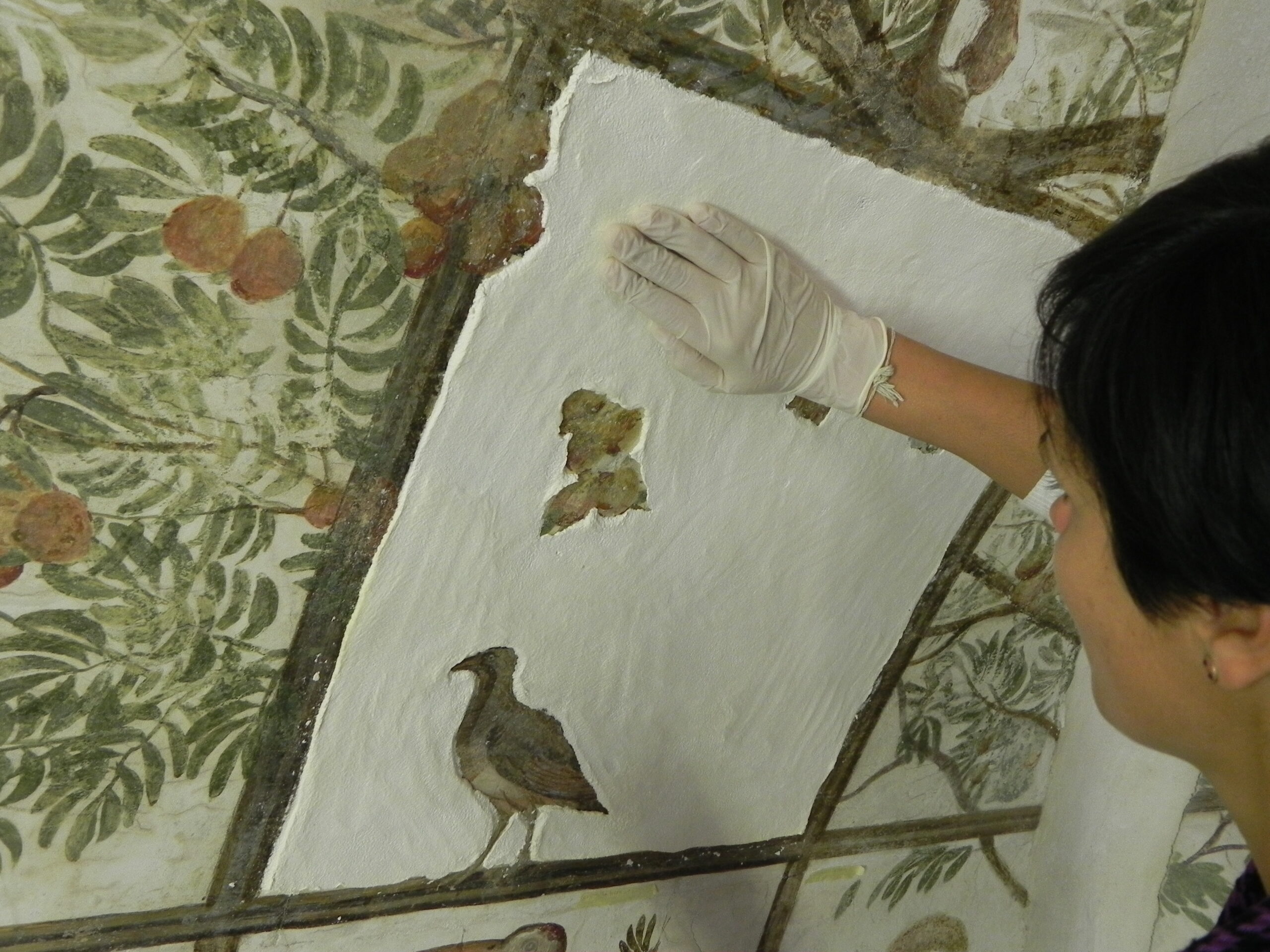
Restoration campaign for the frescoes in the Chamber of Birds, 2011
© AFR
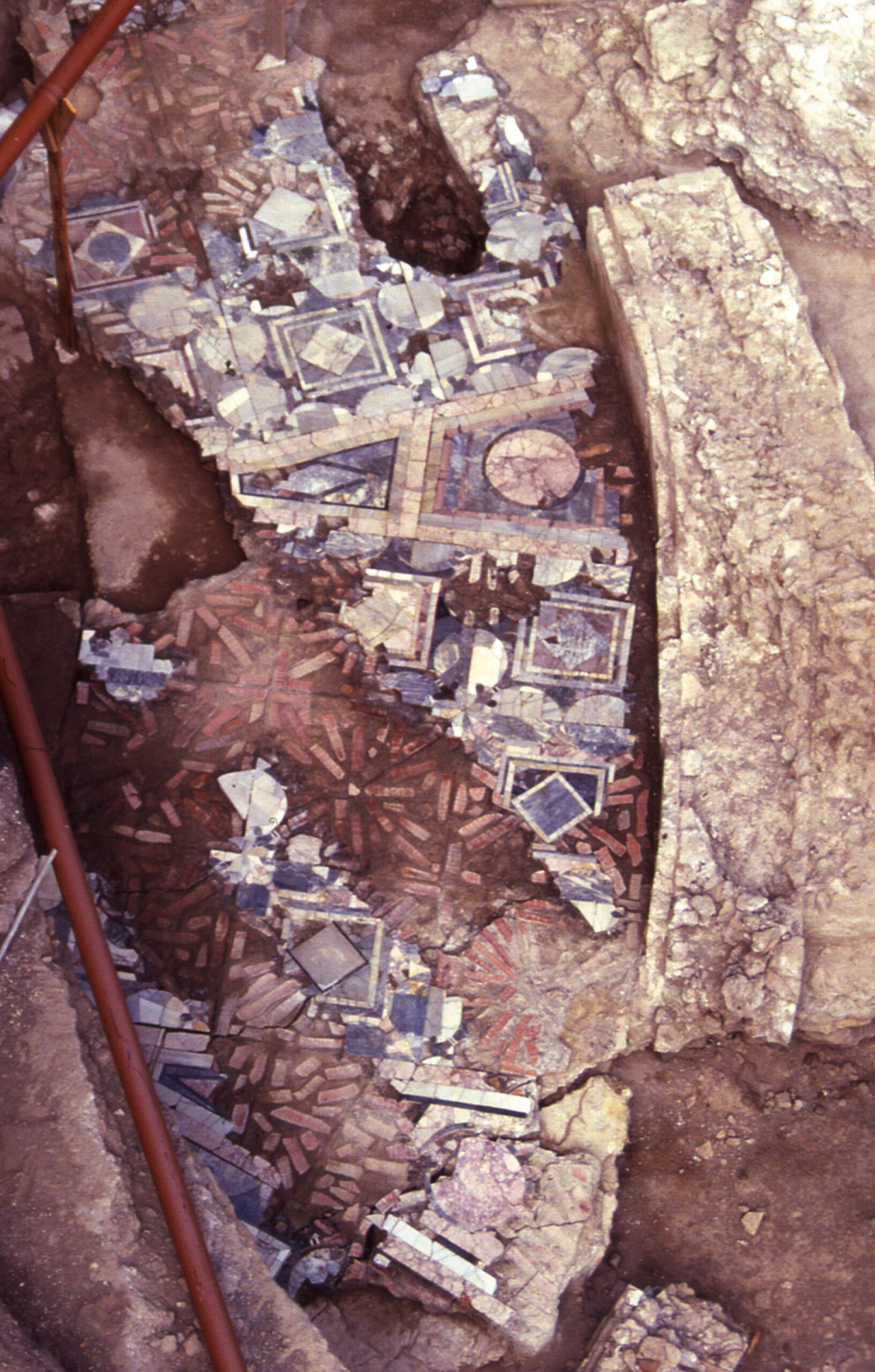
Pavement in the semicircular portico of the palace of Honorius, 5th century AD, uncovered during excavations carried out in 1999 beneath Villa Medici
© AFR
Scientific publications
The Department’s publishing programme centres on publications devoted to art history, including the journal Studiolo, the Collection d’histoire de l’art, exhibition catalogues, and works on the history of the French Academy in Rome and Villa Medici. It also includes publications based on the work of residents and fellows.
Studiolo, the Villa Medici’s Art History Journal
Founded in 2002 by the French Academy in Rome – Villa Medici, Studiolo is a yearly international art history journal published in three languages (French, Italian, and English) and A-rated by Italy’s National Agency for the Evaluation of Universities and Research (ANVUR). It publishes critical and historiographical pieces covering the modern and contemporary periods across all geographical areas.
By embracing a wide range of methodological approaches, it encourages interdisciplinary dialogue. Each issue features a thematic Dossier along with several regular sections: Varia, open to submissions outside the main theme; Débats, dedicated to historiography; Villa Médicis, histoire et patrimoine, covering the history of the French Academy in Rome and the restoration projects led by the Art History Department. Finally, Champ libre opens its pages to current year residents.
The first 14 issues of Studiolo are available freely accessible on Persée.
Article Evaluation Procedure
Studiolo reviews all submitted articles through a double-blind peer review process. This guarantees a fair and transparent assessment of the submissions while ensuring that both authors and reviewers remain anonymous throughout the review procedure.
Each manuscript is read by two experts – one internal to the editorial committee, one external – chosen based on how well their expertise matches the subject of the examined contribution. If the two reviews conflict, a third expert is brought in, anonymously again. The final call on publication then goes to the scientific editors of the issue.
Articles are assessed on three main criteria: originality, scholarly rigor, and clarity of presentation.
Ethics
The editorial ethics of Studiolo follow international standards, in line with the COPE Code of Conduct and Best Practice Guidelines for Journal Editors.
Responsibilities of the Author
Originality
Submitted articles must be original and not under consideration at any other journal at the same time.
References and Citations
All sources must be properly and rigorously cited in line with academic standards.
Authorship
Only those who have genuinely contributed to the research and writing should be listed as authors.
Revisions
Authors agree to address the changes suggested by reviewers during the evaluation process.
Corrections
Authors must promptly flag any significant error found after submission or publication.
Responsibilities of the Reviewers
Confidentiality
Manuscripts sent for review are strictly confidential and must not be shared or used outside of the publication process of the journal.Impartiality
Reviews must be fair, well-argued, respectful and grounded in clear academic criteria.Conflicts or Availability
If a reviewer feels unqualified to assess a manuscript or unable to meet the deadline, they must let the editorial team know as soon as possible.Responsabilities of the Editorial Team
Editorial Decision
The final publication decision lies with the editor-in-chief, informed by the reviewers’ assessments.Impartiality
Articles are selected without any discrimination based on gender, sexual orientation, religion, political views, or any other personal characteristics.Peer Review
All submissions go through double-blind peer review, ensuring no conflicts of interest between authors and reviewers.Editorial Committee
Francesca Alberti (The National Gallery London)
Marc Bayard (Mobilier national)
Diane H. Bodart (Collège de France)
Luisa Capodieci (Université de Lorraine)
Stefano Chiodi (Università degli Studi di Roma Tre)
Frédéric Cousinié (Université de Rouen Normandie)
Ralph Dekoninck (Université de Louvain)
Jérôme Delaplanche (Centre des monuments nationaux)
Antonella Fenech (CNRS / Centre André Chastel)
Elena Fumagalli (Università degli Studi di Modena e Reggio Emilia)
Sophie Harent (Musée national Magnin)
Michel Hochmann (EPHE)
Anne-Violaine Houcke (Université Paris-Nanterre)
Dominique Jarrassé (Université de Bordeaux Montaigne)
Annick Lemoine (Musée d’Orsay)
Maria Grazia Messina (Università degli Studi di Firenze)
Patrick Michel (Université de Lille)
Patricia Rubin (Institute of Fine Arts, New York University)
Maddalena Scimemi (Università degli Studi di Roma Tre)
Tiziana Serena (Università degli Studi di Firenze)
Anne-Elisabeth Spica (Université de Versailles-Saint-Quentin-en-Yvelines)
Giovanna Zapperi (Université de Genève)Scientific Committee
Olivier Bonfait
Marisa Dalai Emiliani
Sybille Ebert-Schifferer
Catherine Goguel
Alvar González-Palacios
Yves Hersant
Christophe Leribault
Brigitte Marin
Bert W. Meijer
Philippe Morel
Anna Ottani Cavina
Gérard Régnier
Pierre Rosenberg
Victor I. Stoichita
Henri Zerner
The “Art History Collection”
The “Art History Collection” of the French Academy in Rome is dedicated to the publication of collective works arising from conferences, seminars, study days and research workshops organised by the Department of Art History, often in collaboration with international institutions and universities. The choice of themes and the selection of essays that encourage contemporary debate give this collection a resolutely international dimension.
The collections
The French Academy in Rome holds a collection of over 5,000 works, some of which are on display in Villa Medici and its gardens. It comprises a significant collection of plaster casts, the oldest of which date back to the time of the Academy’s foundation, 17th- and 18th-century tapestries, ancient sculptures from the Medici collection, and medals. The collection of paintings comprises around 500 works, including 463 portraits of residents produced between 1798 and 1936.
The Academy also owns several historical musical instruments, a collection of antique and contemporary furniture, a collection of graphic arts, and a photo library documenting Villa Medici and its collections. The Academy also holds works on loan from French collections, notably the Mobilier National.
Since 2012 and the establishment of the ‘heritage mission’, the Department of Art History has been carrying out the inventory, study and conservation of the collection.
Collection News
The Academy’s collection is regularly expanded. In 2026, the cast of the so-called Sarcophagus of Jonah (2026.2.1), donated by the Vatican Museums following the exhibition Shared Holy Places, and La Serlienne from the Balthus I Loggia (2026.1.1), presented by Nicolas Daubanes during the residents’ exhibition (2025), were added to the collections.
Every year, works from the collections are restored. Recent projects include the restoration of the Niobides group and the restoration programme for musical instruments. The Academy is gradually making its collections available online via the Antin database. In 2026, more than 1,200 drawings from the Alfred-Nicolas Normand Collection were added.
Find out more about Villa Medici’s collections
Explore the collections database: Antin database
The archives
The Villa Medici holds within its walls some of the documents produced in the course of the activities of the French Academy in Rome. Most of the Academy’s archive material prior to its move to Villa Medici in 1803 was destroyed during the sacking of the Palazzo Mancini in 1793. As part of a policy to preserve the documents and facilitate access to them, the Academy has undertaken the transfer of its historical archives. The archives produced between 1801 and 1872 are now held at the National Archives in Pierrefitte-sur-Seine (France). The transferred archives have been digitised and are available online at: https://archives.villamedici.it/index.php/.
The archive collections include correspondence from directors, the institution’s financial management, records relating to the buildings and gardens, exhibitions and cultural events, as well as descriptions of the residents’ work. The collections comprise a wide variety of materials: manuscripts, photographs, plans and digital data.
Consult the Frequently Asked Questions (Conducting research section) if you have any questions.
How to consult the archives
On-line consultation:
The Academy’s archives are housed at the Archives nationales (Pierrefitte-sur-Seine, France) and can be consulted at the following address: link.
On-site consultation:
Archives that have not yet been deposited with the Archives nationales can be consulted at Villa Medici by appointment. Consultations take place on Wednesday and Thursday mornings, from 9am to 1pm.
To make an appointment, please contact
Patrizia Celli: [email protected]
Procedure
When making your request, please indicate the subject of your research, the files you wish to consult and the date on which you wish to come to Villa Medici to consult the documents. Your appointment will be confirmed by email. On site, you will be asked to fill in a form and present some form of identification with a photo.
Consultation is limited to 5 archive boxes per reader per morning. It is necessary to have requested in advance the archive boxes to be consulted when making the appointment.
Any reader who fails to honor a reserved time slot more than twice without a valid reason may be temporarily or permanently refused access to new time slots.
The library
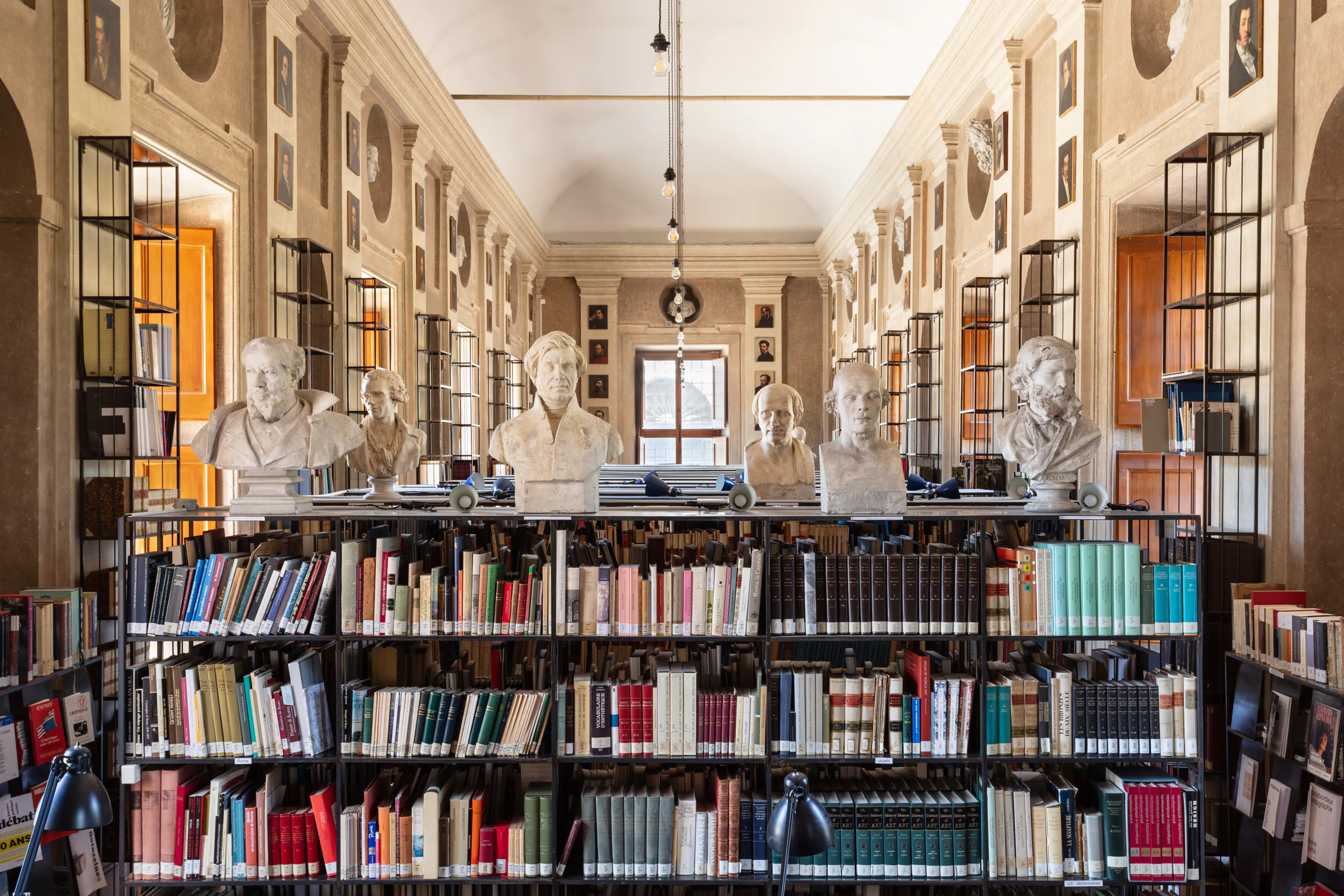
Housed in Ferdinand de’ Medici’s former gallery of antiquities, the library of the French Academy in Rome was founded in 1803 by Joseph-Benoît Suvée, who served as director from 1795 to 1807. It holds over 38,000 volumes and 40 periodical subscriptions, reflecting the history and current developments in the disciplines represented at theVilla Medici. The collection covers the visual arts, architecture, art history, music (including numerous scores of contemporary music), photography, cinema, as well as literature and comic books.
The library holds a collection of rare books comprising around 1,800 volumes (including 800 dating from before 1800) and a collection of historical and modern musical scores comprising around 2,400 items. One of the library’s missions is to provide as accurate a picture as possible of current developments in the arts by acquiring catalogues of major exhibitions and the most important monographs on artists.
Explore the library book catalogues online
Catalogue Farnese
Catalogue SUDOC
Catalogue URBiS
If you have any questions, please consult the Frequently Asked Questions (Conducting research section)
The Fonds of antique books
The collection of antique books consists mainly of 18th-century editions, but also includes seven 16th-century books and thirty-two 17th-century editions. These include works on Félibien, Pietro Santi Bartoli, Les Gravures du Cabinet du Roi and Bernard de Montfaucon’s L’Antiquité expliquée. An almost complete collection of Piranesi’s engravings and several accounts of travels in Italy (Lalande, Labat, l’Abbé de Saint-Non) make up the other most valuable works in the early collection. Finally, the history of art is represented by rare editions of various theoretical treatises (Dürer, Félibien, Roger de Piles, Mengs, Winckelmann). As for architecture, in addition to classical treatises, there are numerous volumes describing Rome: Desgodez, Guattani, Falda, Percier et Fontaine, Bartoli, Lagardette.
In the 19th century section, in addition to art history (La Vie des peintres by Landon), the collection focuses on two main fields: architecture, with major works by Quatremère de Quincy, Viollet-Le-Duc, Canina and Valadier, and music. The early music collection – catalogued with the help of the Palazzetto Bru Zane – consists mainly of opera scores, covering a period from Lully’s earliest printed works to works by Bizet and Saint-Saëns, and including the most prominent protagonists of 18th and 19th-century French theater. Operas by Italian musicians who lived in France during the second half of the 18th century, such as Piccinni, Sacchini and Paisiello, are particularly well represented, as are French scores from the early 19th century. The catalog of pre-1900 scores, compiled by Paolo Russo and Irene Maffei, was published by the Florentine publisher L.S. Olschki, and can now be consulted online.
The library’s “treasures” also include the “Collection Muro Torto”, where Christian Prigent, fellow and writer in 1979-1980, printed collections of poems and short stories on a small manual press. In addition to a number of manuscripts, the library also holds the travel drawings donated to Villa Medici by the heirs of the architect Alfred-Nicolas Normand, and a number of works from the Nadia Boulanger Bequest.
How to access the library
The library is primarily available to Villa Medici fellows and residents for their research and work. Secondly, it is accessible to any researcher, teacher, curator or student who can show that they are doing scientific research on a subject that is compatible with the library’s collection.
Access conditions
Access to the library is by appointment only and subject to availability.
External readers can schedule an appointment by contacting:Raffaella Carchesio, librarian at the French Academy in Rome – Villa Medici
[email protected] / +39 06 67 61 263Books available
Villa Medici books are listed in the following online catalogues:
The Villa Medici librarian can help with title searches on site.
The digital resources
Villa Medici provides the public and researchers with six digital platforms to explore the premises, collections and history of the French Academy in Rome.
Base d’Antin: It is the database for the collection of the French Academy in Rome – Villa Medici. Users can browse by keyword or by filtering by type of work or group.
Archives of Villa Medici: It brings toether more than 6,000 documents relating to the correspondence of the directors, financial management of the institution, monitoring of buildings and gardens, cultural events and descriptions of the work of fellows.
Biographical dictionary of the fellows of the French Academy in Rome: It lists the fellows from 1666 to 1968, when the Prix de Rome competition was abolished. The individual records of the fellows provide biographical and professional information such as places of birth and death, studies, Repertory of Expeditions from Rome, occupations, awards and honours.
Répertoire des envois de Rome en peinture et sculpture: It lists tje “Envois de Rome, e.e. works produced by paintors and sculptors fellows between 1804 and 1914 and sent to France each year.
Issues of Studiolo journal freely available on Persée: Several issues of Studiolo, Villa Medici art history journal, are available for free and for download on Persée portal.
Album of Villa Medici: It brings together, in the form of a shared platform, several tousand of amateur photographs that bear witness to the lives of the inhabitants, residents, guests and teams of Villa Medici from 1850 to the present day.
Further reading: General bibliography on the Villa Medici and the French Academy in Rome (Fr)
The art history residencies
Villa Medici hosts art historians and theorists, curators and art conservators for one-year residencies (the fellows). Other schemes offer opportunities for shorter stays: Medici Residency Daniel Arasse in partnership with the École française de Rome (eight fellowships per year for PhD students or early-career postdoctoral researchers); Medici Residency André Chastel Residency in partnership with the Institut national d’histoire de l’art (two researchers per year); and the Medici Residency in partnership with the Kunsthistorisches Institut in Florence.
Since 2027, an INHA x Villa Medici Post-Residency programme has enabled residents who have already completed a research stay at the French Academy in Rome – Villa Medici to benefit from an additional year of research at the INHA.
Find out more about our residency programs and current residents and fellows
Browse the Pages
The publications
Find all the exhibition catalogues, art history publications, guides and other works published or co-published by Villa Medici.
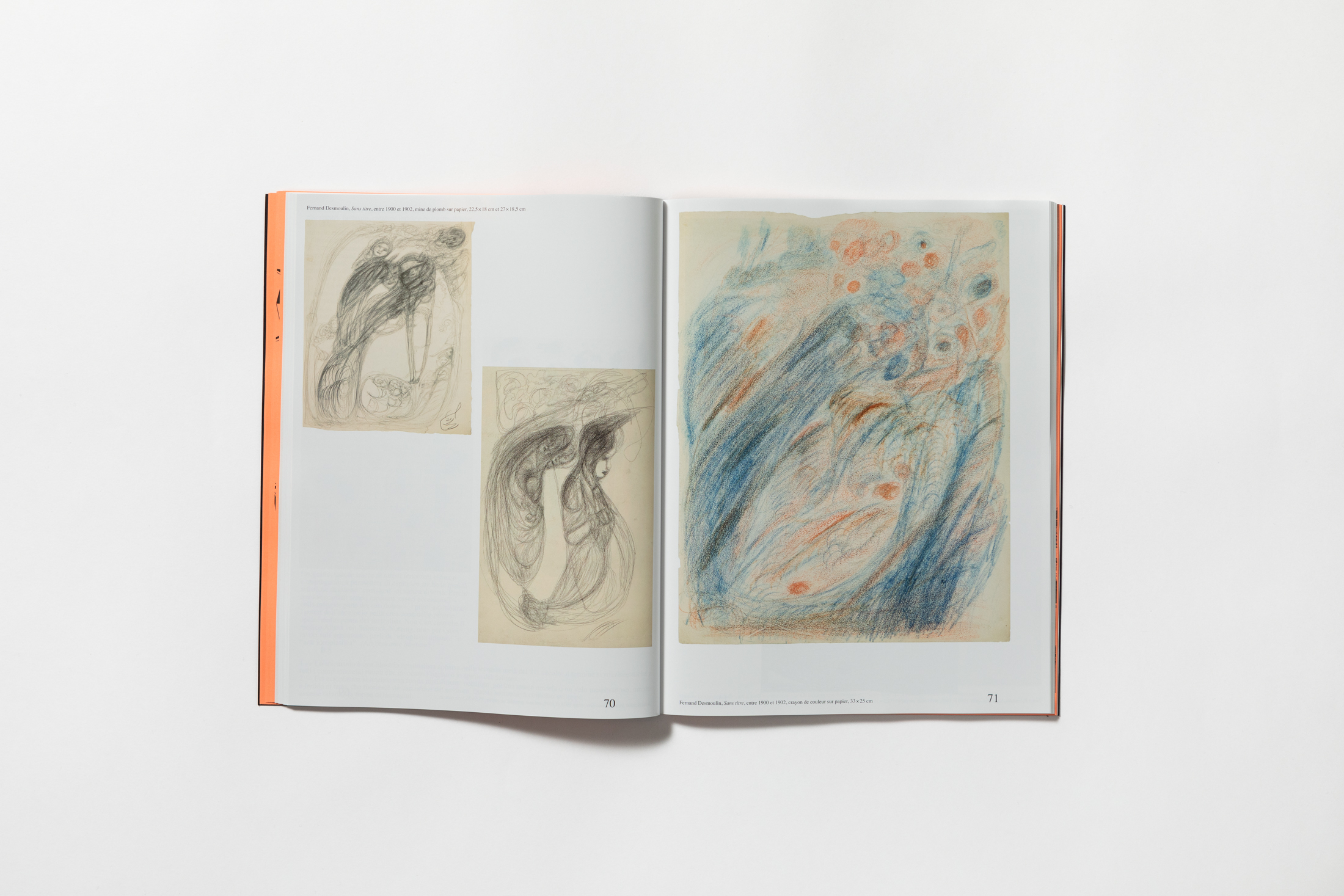
A Heritage to Preserve
The collections
Villa Medici's collections include thousands of objects dating from the 17th century to present day, testimonials to the villa's history and its many different functions: from the prestigious residence of Cardinal Ferdinando de' Medici to the home of the French Academy in Rome.